AI-assisted couples support: private conversations for each partner, neutral mediation, and simulations to practise difficult conversations.
 Fictional data
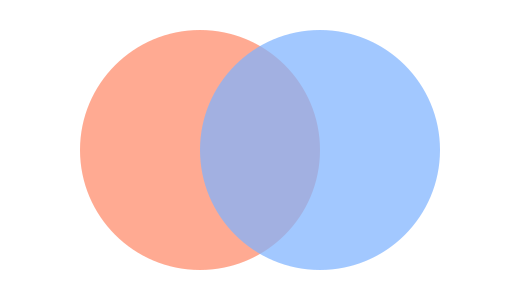
Even with the best intentions, each person speaks their own emotional language and communicates in their own way. When two different languages meet, misunderstandings arise easily: what one says is not what the other hears.
And in worn-out relationships we also tend to read the other person's words in the worst possible light. The agent acts as a translator: it helps you say things so they land as you intend, and hear them as they were meant.
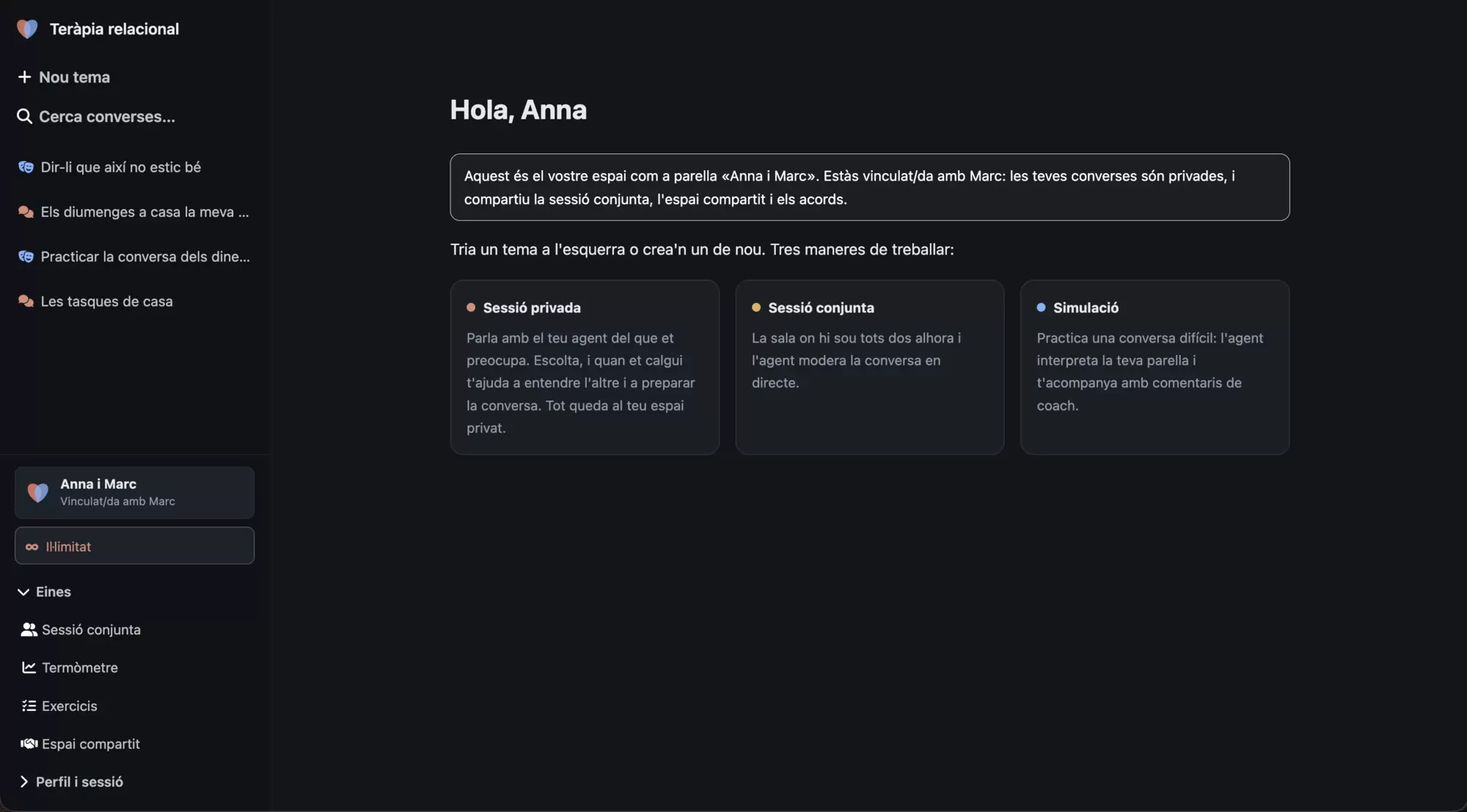
Talk to your agent about what worries you: it listens, validates and helps you turn reproaches into needs. When you need to understand your partner or prepare a difficult conversation, it works with whatever you have both consented to share. Everything stays in your private space.
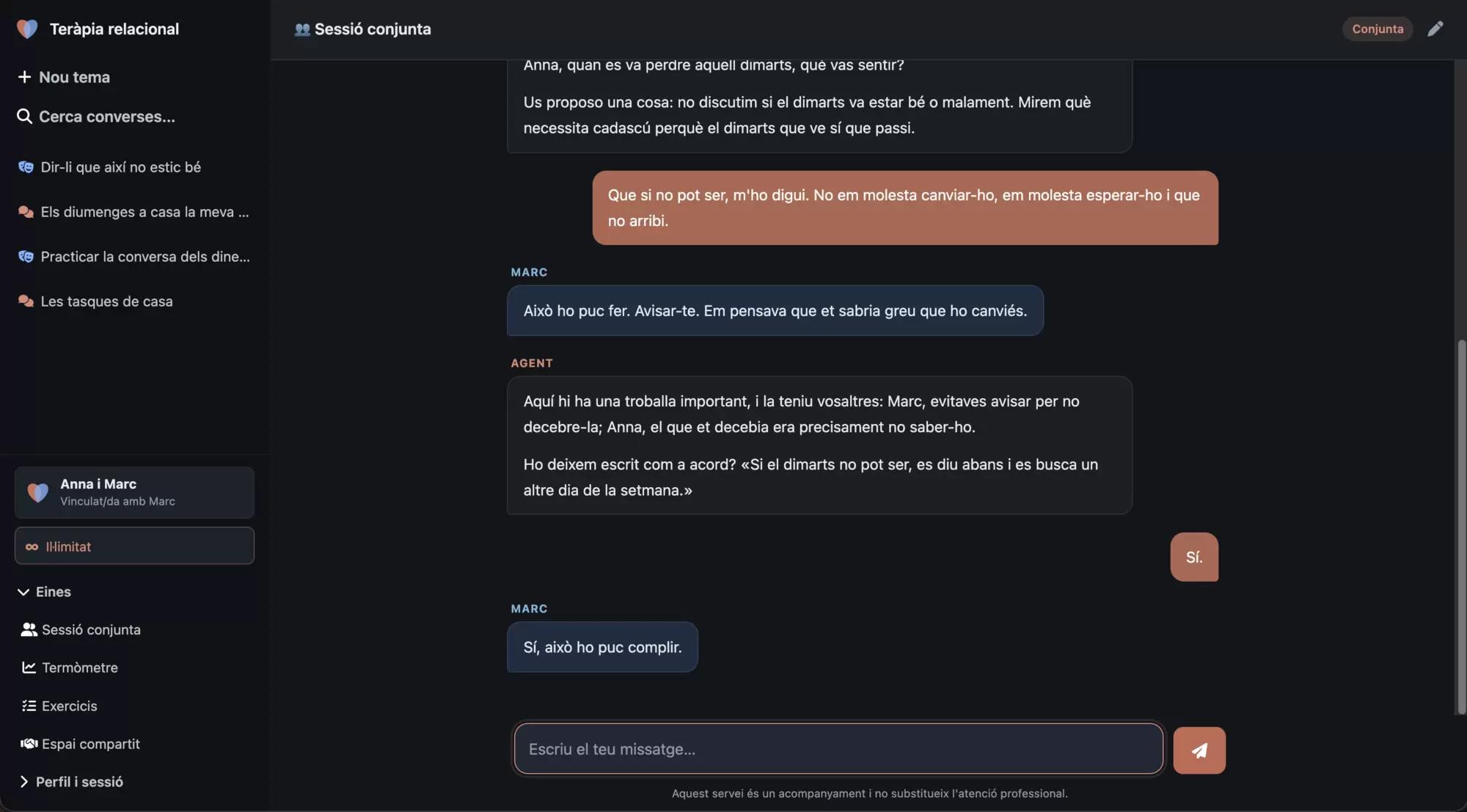
A room where you are both present and the agent moderates live: it shares out the floor, stops the loops and helps you reach agreements.
Practise a difficult conversation: the agent plays your partner and adds coaching comments showing the tensions and how to rephrase them.
The agent doesn't improvise: it works with the couples-therapy techniques with the strongest scientific evidence, built into its instructions and applied in every conversation.
It spots the "four horsemen" (criticism, contempt, defensiveness, stonewalling) and teaches their antidotes: soft start-up, appreciation, taking responsibility and breaks. It encourages the 5:1 positive-interaction ratio.
Beneath anger and reproach there is usually fear, sadness or a need for connection. The agent helps find and express that primary emotion, and makes the pursue-withdraw cycle visible.
Observation, feeling, need and request: turning reproaches into clear requests, and always validating before arguing. A feeling is not to be rebutted; it is to be heard.
Many conflicts are perpetual because they stem from differences in character. The goal is not always to solve them: it is also to learn to talk about them with acceptance and team up against the pattern, not against each other.
Each technique is introduced by name when you actually need it —one at a time, applied to what you are living that day— and then stays one click away if you want to reread it. Once you have really used it and it worked, it goes into your learning notebook. The point is that you keep them: a soft startup or a well-timed break serve you for life, including the day you stop using this.
This is not marketing decoration: these techniques are part of the agent's actual instructions and it actively applies them in conversations, simulations and joint sessions.
Cures.cat uses a methodology new to therapy: it draws not only on the tools of psychology but on a philosophical model of how any living reality works — a person, a couple, a community. It is the Globàlium of Lluís M. Xirinacs (1932-2007), which holds that every living reality unfolds along several dimensions at once, none of which can stand in for another: health is not excelling at one but abandoning none — leave one untended long enough and that is where the trouble surfaces, however well the others are going. From its thesis we have derived the meta-globàlium, a computable model precise enough for an artificial intelligence to use as a criterion rather than a metaphor.
There is always a part of your life that nobody ever looks at. Therapy always goes where it hurts —conflict, emotions— and leaves whole dimensions unlooked at. The agent carries six on its list and skips none.
Do you talk it all through and nothing changes?
What have you learned to do together that you couldn't before?
Could you say how you are — and would you both say the same?
Would you describe the life you have the same way?
Who else is in this, besides the two of you?
What brought you together — where is it now?
If all six have to be tended, fixing one may have emptied another. They sorted the money out and stopped arguing; they also stopped looking at each other. What did you sacrifice to get there? It's the question that closes every turn, and almost nobody asks it.
Public and freely licensed — Opengea SCCL, CC BY-SA.
Each partner has a fully private account and space. Your partner cannot read your conversations, and the agent will never reveal them:
A single sign-up creates both linked accounts, each with its own email and password.
The agent opens the conversation and asks the questions needed to understand your situation.
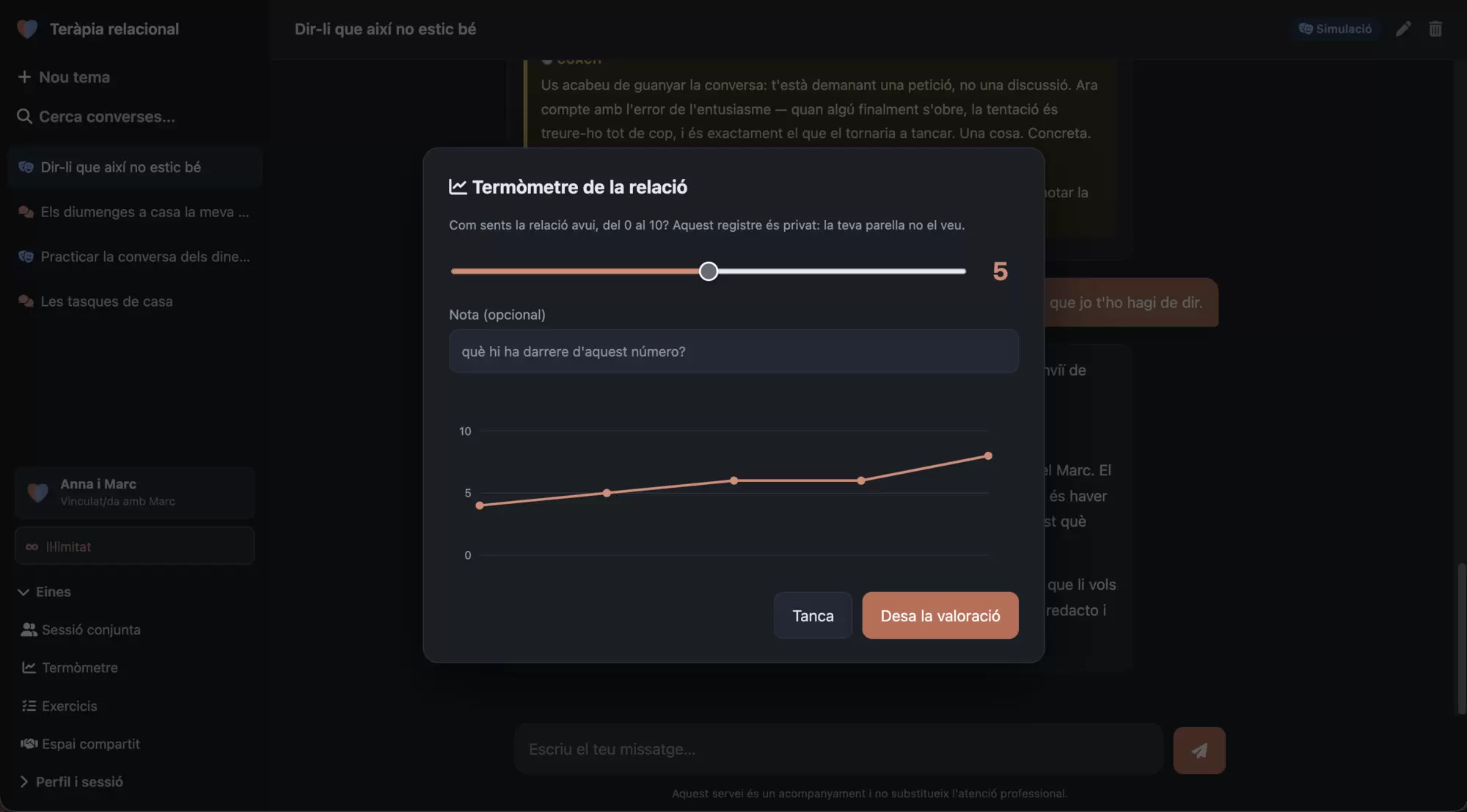
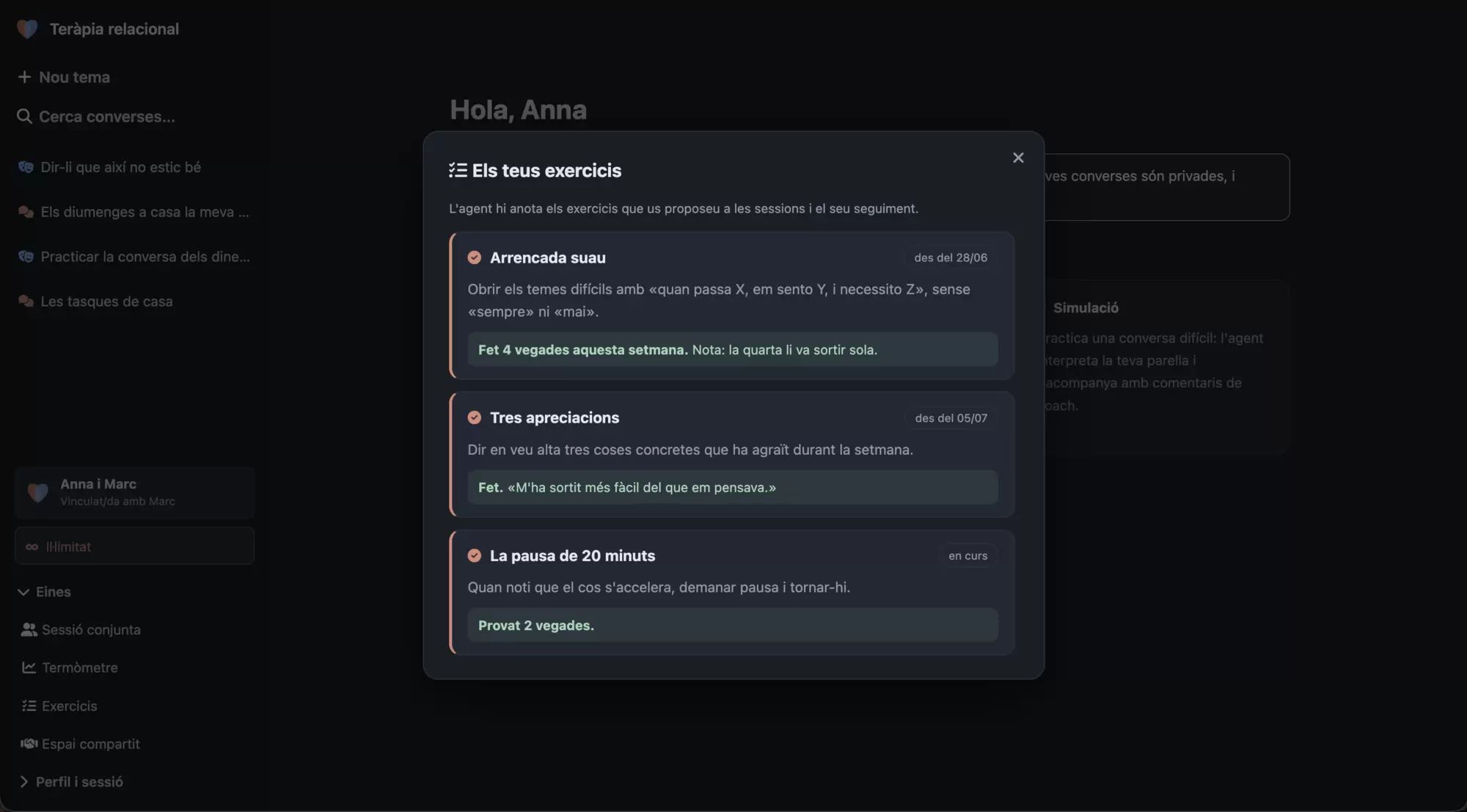
Topics per conversation, moderated joint sessions, weekly check-in, relationship thermometer and exercises with follow-up.
The agreements you reach are kept in a shared space, always with the consent of both.
Choose how you want to be accompanied, and change it whenever you like. Reminders come by email, and saying how the relationship is going takes a single click.
There is no subscription and no commitment. You top up a balance with a pay-what-you-want contribution (€5-50) and each agent reply deducts the real cost of the AI's work — the tokens each conversation consumes. Fully transparent: all prices include 21% VAT, you can see your balance at any time in the app, and every month you receive a simplified invoice for what you have used.
Each message of yours with the agent's reply usually costs between €0.10 and €0.35 (VAT included), depending on the length and depth of the conversation.
An hour of session (15-20 exchanges) usually comes to €3-7, VAT included — most stay under €5. For reference, an hour of in-person couples therapy costs €60-90.
With one or two sessions a week plus the check-ins, most couples would spend €12-30 a month, VAT included.
Your balance never expires and can be topped up at any time. Every amount you see includes 21% VAT, and each month you receive a simplified invoice with the net amount and the VAT broken down. This support does not replace professional therapy when it is needed.
Answer them separately or together — when your answers don't match, that says something too. Wherever the "no" answers pile up, that's the perspective nobody has looked through for a while. Nothing is sent anywhere: the result is computed right here.
What you agree on — does it happen, and does it last?
When a conversation goes badly, do you learn something — or is it swept away?
Do you have your own rules as a couple — an "in this house we don't do that"?
What the last crisis taught you — is it still with you?
Can you tell each other what you think without fear?
Could you say how you are as a couple — and would the same sentence come out?
Would you both describe your life as a whole the same way?
Do you find moments to look beyond each week's logistics?
Is it clear what belongs to each of you, and what belongs to both?
When life arrives from outside — family, work, surprises — does it find you as a team?
Could you say what you want as a couple, beyond what needs doing?
What brought you together — do you still know how to find it?
Whatever the result, the way to work on it is the same: guided conversations in your own space, each from your own side — and the agent is already watching all six perspectives for you.
No, and it does not try to. It is support available every day, at any hour, to work on what happens between sessions or when in-person therapy is not an option. If there is violence, abuse or risk to anyone, the agent stops the exercise and points you to immediate professional help.
No. Each person has their own space, technically isolated: your partner cannot access it and neither can their agent. The only thing that crosses over is what you write in the shared space, always after reviewing it and always revocable.
Nobody. Not for advertising, not to profile you, not to train AI models, not to sell anything to third parties. The servers are our own and are in the European Union.
Signing up creates both accounts, but each of you goes at your own pace. Using it on your own already helps; what improves a lot with both of you on board is simulation and the joint session, because they build on what each of you has chosen to share.
It is tuned for couples, but not exclusive to them: if you share another close bond — parent and adult child, siblings, a lifelong friendship — you can work here too. Tell the agent what your bond is and it will adapt: it will speak of it in your own words and use only the tools that fit (not the couple-specific ones). The joint room, mediation and agreements work for any bond between two people.
There is no subscription and no commitment. You top up a balance with a pay-what-you-want contribution (€5-50, VAT included) and each reply deducts the real cost of the AI's work: between €0.10 and €0.35 per exchange — an hour of session usually comes to €3-7, most under €5, with 21% VAT already included. You can see your balance at any time, you receive a simplified invoice for your usage every month, and you can delete your account and all data whenever you want.
Catalan, Spanish and English. The agent replies in whichever language you use.
It is instructed to do the opposite. The agent helps you spot your own interpretation bias and negative feedback loops, and shows you how your messages may be coming across. And the simulation is not based on your version of the other person: it is built on what your partner chose to explain about themselves in the shared space, in their own validated words.
Yes, like any artificial intelligence, which is why its playing field is limited: it does not diagnose, does not judge and does not handle crises — it works only with communication patterns, emotions and needs, applying the techniques from the methodology section, without pulling information from the internet. If a reply seems biased or off to you, write to cures@cures.cat: the instructions are shared, so a fix reaches everyone at once.
The risk is real and the design works against it: everything points back to the real conversation (preparing it, rehearsing it, doing exercises together, the joint session), and there is no engagement machinery — no streaks, no subscription we would want to stretch. You decide the reminders yourselves (which days, until when, or none at all in pause mode), one click silences them, and what we propose by default is an accompaniment with an end date. And if the agent notices that talking to it is replacing talking to the other person, it will say so.
For some conflicts the best tool is a human one, and we want to point you to it: in Catalonia, the Generalitat's public mediation service offers family mediation with professional mediators, free or at a set fee. And if there is suffering that goes beyond communication, a licensed psychologist or your primary-care centre is the way. The agent itself will recommend this when it sees it.
Sign-up is open: a single sign-up creates both accounts. Activate your sessions by topping up a balance with a pay-what-you-want contribution (€5-50, VAT included), drawn down according to the AI's real usage in each session. No subscription, no commitment, and you can delete your account and all data whenever you want.

